The third-party logistics sector has grown into a trillion-dollar industry, with continued expansion expected throughout the decade. This rapid growth highlights how central outsourced logistics has become to scaling modern supply chains.
As companies evaluate fulfillment solutions, two primary operating models tend to emerge: Third-Party Logistics (3PL) and Fourth-Party Logistics (4PL).
Although 3PL providers are widely used for day-to-day fulfillment and distribution, 4PL solutions take on a broader role, focusing on coordination, integration, and strategic control across the entire logistics ecosystem.
If you’re considering handing over logistics operations to an external partner, it’s essential to understand which approach aligns best with your business objectives and complexity level.
In the sections below, we’ll explore:
- how 3PL and 4PL models differ in scope and responsibility
- the operational role each model plays within the supply chain
- key factors to consider when selecting a logistics partner that supports your current scale and future growth
What Is a 3PL (Third-Party Logistics Provider)?
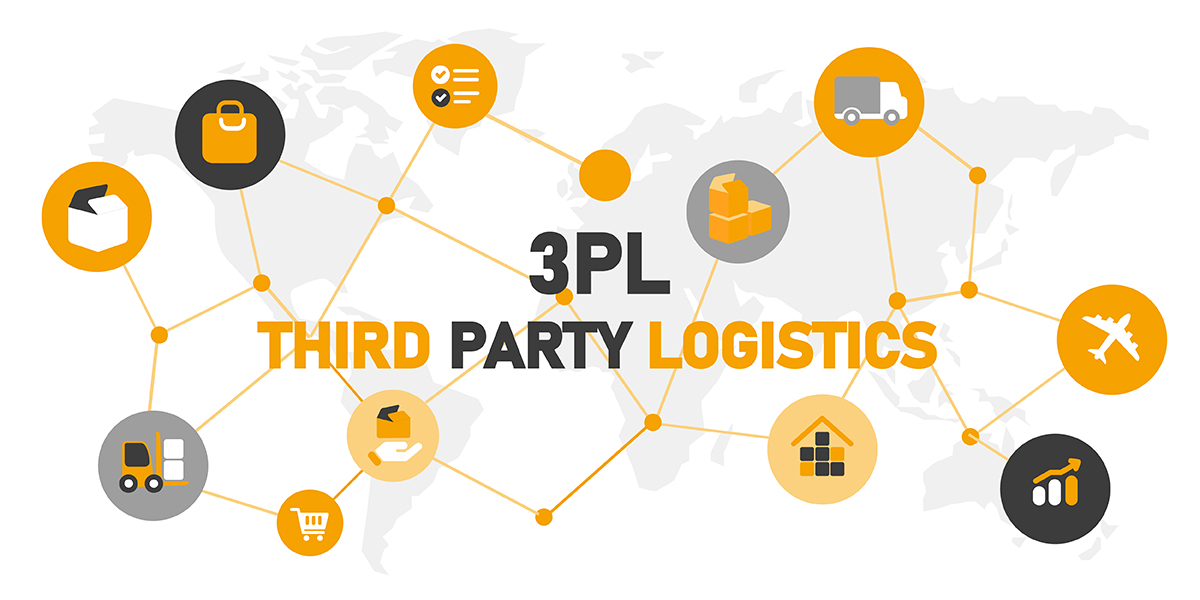
A 3PL provider is an external partner that takes over operational logistics activities for a business. Rather than simply coordinating shipments, it operates physical infrastructure such as warehouses and fulfillment centers, supported by its own workforce and equipment.
Typical 3PL services include:
- Warehousing: storing products within managed facilities
- Stock control: tracking inventory levels in real time and syncing data with sales platforms
- Order processing: handling picking, packing, and order preparation
- Transportation management: securing shipping agreements with major carriers like UPS, FedEx, and DHL and overseeing delivery execution
- Reverse logistics: managing product returns, restocking items, and updating inventory records
In practice, a 3PL functions as the operational link between your company and the transportation networks that move products to end customers, allowing you to outsource execution while maintaining commercial control.
What Is a 4PL (Fourth-Party Logistics Provider)?
Fourth-party logistics providers are gaining traction as supply chains become more complex and data-driven. The steady expansion of the 4PL market reflects a broader shift from operational outsourcing to holistic supply chain orchestration.
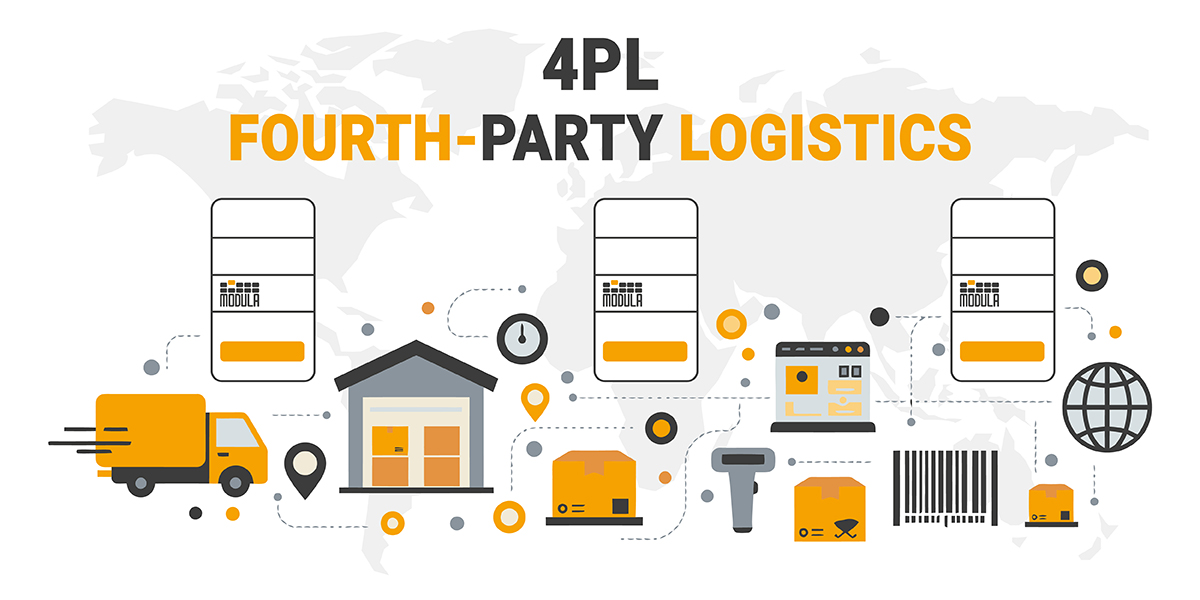
Where a 3PL is responsible for executing specific logistics tasks, a 4PL operates at a higher level, taking ownership of overall supply chain coordination and performance. In most cases, a 4PL does not own physical assets such as warehouses, fleets, or fulfillment equipment.
Key responsibilities typically include:
- Oversight of multiple 3PL partners, ensuring alignment and performance consistency
- Cross-regional coordination, connecting logistics activities across countries or markets
- Technology integration, consolidating data from different systems into a single control layer
- Supply chain design and optimization, covering planning, governance, and continuous improvement
Rather than executing logistics operations directly, a 4PL acts as a central architect of the supply chain, aligning providers, processes, and technology to deliver an integrated, end-to-end logistics strategy.
Differences between 3PL and 4PL
The core distinction between the two models centers on ownership and decision-making authority. A 3PL is primarily responsible for operational execution—physically handling and moving products—whereas a 4PL operates at a strategic level, orchestrating the entire logistics ecosystem.
When businesses outsource fulfillment activities such as warehousing, picking, packing, and shipping to a 3PL, internal teams are freed from operational complexity. This allows companies to redirect resources toward growth-driving functions like sales, marketing, and customer experience, without the overhead of managing logistics infrastructure.
For many fast-scaling brands, partnering with a single 3PL provides a practical way to simplify fulfillment while maintaining a clear path to predictable, scalable expansion.
A 4PL, on the other hand, functions as a supply chain architect. Instead of handling fulfillment directly, it coordinates and governs multiple 3PL providers, aligning performance, suppliers, and logistics processes to optimize efficiency across the entire supply chain.
How a 3PL Fulfillment Workflow Operates
How does a third-party logistics provider handle orders once you outsource fulfillment? While specifics vary by provider, most 3PL workflows follow a similar operational sequence.
Step 1: Bulk inventory delivery to the fulfillment center
Products are shipped in consolidated loads from your facilities or suppliers to the 3PL’s warehouse. Upon arrival, inbound shipments are checked against shipping documentation to confirm quantities and product accuracy.
Step 2: Goods intake and warehouse placement
Once verified, items are registered in the 3PL’s inventory system and assigned storage locations. Warehouse Management Systems (WMS) are commonly used to monitor stock levels and movement in real time.
To maximize efficiency, many providers rely on automated storage solutions—such as Modula vertical lift modules—which improve space utilization, accelerate picking operations, and integrate directly with WMS platforms. This enables higher throughput without increasing labor or warehouse footprint.
Step 3: Order transmission from sales channels
When a customer completes a purchase through your ecommerce store or sales platform, the order information is automatically synced with the 3PL’s system, triggering fulfillment.
Step 4: Order picking and packing
Items are retrieved either by warehouse operators or automated technologies like robotic picking systems. Each order is verified for accuracy, packaged using appropriate materials, and prepared for dispatch.
Precision at this stage is essential. Automated picking solutions—such as Modula vertical lift modules—can visually guide operators to the exact SKU location using laser indicators, reaching picking accuracy levels of up to 99.9% and significantly reducing shipping errors.
Step 5: Shipment execution
The 3PL selects the most efficient carrier based on cost and delivery requirements, prints shipping documentation, and dispatches the order directly to the end customer. Tracking details are typically shared in real time.
Step 6: Returns and reverse logistics
If a return is initiated, the 3PL manages the intake, inspection, and disposition of the item. Returned products may be restocked, refurbished, or discarded according to predefined client rules.
How a 4PL Operating Model Works
The primary purpose of a fourth-party logistics provider is to remove the operational and managerial burden of supply chain coordination from the client. Acting as a centralized “control layer,” a 4PL oversees planning, execution alignment, and performance across the entire logistics network.
Step 1: Supply chain and transport network planning
The process begins with the design of an optimized logistics network. Based on demand projections and service requirements, the 4PL defines how goods should flow from manufacturers to regional fulfillment points. This includes allocating volumes across different geographic nodes to balance cost, speed, and inventory availability.
Step 2: Partner and facility orchestration
Rather than owning warehouses or fleets, a 4PL is responsible for selecting and managing the logistics partners that do. It appoints 3PL providers to operate storage and fulfillment activities in strategically chosen locations.
More mature 4PLs tend to favor partners that leverage warehouse automation—such as Modula vertical lift modules—because automation helps enforce consistent performance standards, safety levels, and throughput across a distributed network.
Step 3: Unified inventory visibility
Inventory oversight is handled through centralized digital platforms that aggregate data from all connected warehouses. This allows businesses to track stock availability across regions in real time from a single interface.
At this stage, system integration is essential. Warehouses equipped with solutions like Modula IoT (Cloud) can stream inventory data and machine status directly into the 4PL’s control environment, reducing reliance on manual updates and enabling continuous, accurate supply chain monitoring.
Step 4: Delivery coordination and exception management
In the final phase, the 4PL focuses on outbound execution and last-mile efficiency. It aligns local 3PLs and carriers to ensure timely pickups and deliveries, while centrally managing disruptions, delays, or service exceptions to maintain overall performance targets.
3PL vs. 4PL Logistics: Choosing the Right Model for Your Business
Not sure whether a 3PL or a 4PL is the better fit for your operations? The right choice depends largely on your company’s stage of growth, operational complexity, and how much control you want to retain. Below are common scenarios where each model tends to deliver the most value.
1) Early-stage businesses: why a 3PL is often the smartest starting point
Many young companies assume fulfillment must be handled internally at first. In reality, partnering with a 3PL from the outset can accelerate growth while keeping costs predictable.
By outsourcing warehousing and fulfillment activities—such as storage, picking, packing, and shipping—you avoid upfront investments in facilities, equipment, and staff. This frees up capital and management attention for core priorities like product development, brand positioning, and customer acquisition.
2) Rapid growth phase: scaling efficiently with a 3PL
As order volumes increase, internal storage and fulfillment processes often struggle to keep pace. A 3PL can immediately solve capacity constraints, but scalability depends heavily on the provider’s technological capabilities.
Industry analyses frequently cite rising demand and warehouse space shortages as key reasons companies turn to 3PLs. However, capacity alone isn’t enough.
Practical insight: when evaluating partners, look beyond available space. Prioritize 3PLs that invest in automation and smart warehouse technology, as their ability to scale efficiently is closely tied to the systems they use.
Solutions like Modula’s automated storage systems enable advanced 3PLs to:
- absorb sudden order surges with streamlined workflows
- optimize storage density and reduce operating costs
- provide real-time inventory data through system integrations
3) Large, complex operations: when a 4PL becomes relevant
At enterprise scale, logistics management can become fragmented and difficult to control. When multiple providers, regions, and systems are involved, a 4PL can help by centralizing oversight and coordination.
A 4PL takes responsibility for orchestrating the entire supply chain, including managing multiple 3PL relationships. This approach can improve efficiency and visibility, but it also requires companies to relinquish a degree of hands-on control.
For this reason, many high-growth brands choose to continue working with a technologically mature 3PL that can evolve alongside them—offering scalability, transparency, and operational flexibility without fully outsourcing strategic control.
3PL and 4PL: Can They Work Together?
Absolutely—these two models are often complementary. In a combined setup, the 4PL provides high-level governance, directing and aligning the broader supply chain, while individual 3PLs are responsible for executing day-to-day logistics activities.
Enabled by modern logistics technology—such as shared data environments and real-time performance dashboards—a 4PL can coordinate multiple 3PL partners across regions without losing visibility or consistency.
In this structure, operational tasks remain in the hands of 3PL providers, while the 4PL ensures strategic alignment, performance optimization, and end-to-end cohesion across the entire logistics network.
3PL vs. 4PL: Key Points to Remember
- Execution vs. strategy: 3PLs focus on hands-on logistics activities, including warehousing, order preparation, and shipping. 4PLs operate at a higher level, coordinating end-to-end supply chain performance and managing multiple service providers.
- Scalability: Companies in rapid expansion phases often rely on 3PLs for flexible, execution-driven fulfillment. Organizations with large-scale, geographically distributed operations typically turn to 4PLs to gain centralized control and strategic alignment.
- Technology as a differentiator:
Regardless of the model, logistics performance is strongly influenced by the tools in place. Providers that leverage automation—such as Modula vertical lift modules—can achieve higher picking accuracy, better space utilization, and faster throughput compared to fully manual operations.
3PL vs. 4PL logistics: FAQs
3PL vs. 4PL vs. 5PL
- 3PL: manages specific logistics functions such as warehousing, picking, packing, and shipping. Provides direct operational support to businesses.
- 4PL: provides holistic oversight of the supply chain by orchestrating multiple 3PL partners. Its role centers on strategic governance, system integration, and seamless coordination across all logistics activities.
- 5PL: operates at a network-wide level, going beyond individual supply chains to manage complex logistics ecosystems. It emphasizes digital orchestration, advanced automation, and large-scale optimization across multiple clients and markets.
Can a 3PL evolve into a 4PL?
Some 3PL providers expand their service offering by adding elements such as software integration, reporting, or analytics. However, a full 4PL model goes beyond enhanced services. A true 4PL operates as an independent orchestrator, coordinating multiple 3PLs and governing the supply chain from a strategic, vendor-neutral perspective.
When does it make sense to transition from a 3PL to a 4PL?
A shift toward a 4PL is typically considered when logistics operations become highly complex. Common triggers include managing several fulfillment partners at once, entering new international markets, or needing a centralized layer to control supply chain strategy, performance metrics, and technology alignment.
Is a 4PL more costly than a 3PL?
In most cases, yes. Directly partnering with a 3PL is generally the more economical option, particularly when businesses can compare and negotiate rates across providers.
A 4PL introduces an additional management layer between the company and its logistics operators. While this delivers coordination and oversight, it also involves fees or revenue-sharing models, which can increase overall costs and reduce direct price competition among 3PLs.