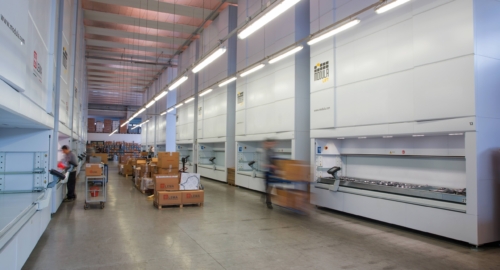
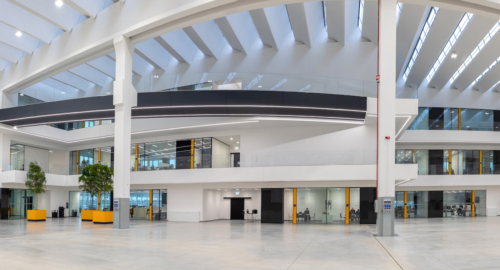
The manufacturing industry is undergoing an unprecedented transformation. Digitalization, automation, and data management are reshaping the boundaries of production, imposing a new paradigm: being efficient, precise, and sustainable.
From the very beginning of its history, when it was still a Business Unit, Modula has made this revolution its mission, radically transforming its production processes to face the challenges of global competitiveness. The result? A path of exponential growth that combines technological innovation, strategic vision, and a culture of continuous improvement.
From a Thin Sheet of Metal to a Complex System: The Courage to Rethink Everything
It all began with an apparently simple but engineering-wise ambitious challenge: to manufacture trays with a load capacity of up to 990 kg starting from a sheet of metal only 1.5 mm thick.
To achieve this, Modula had to “change the paradigms of the process,” redesigning not only production but also the very concept of the product itself. Thus a new industrial philosophy was born, based on efficiency, precision, and waste reduction. The vision of engineer Franco Stefani was decisive. As early as 2017, when the machines produced were just about a thousand, Stefani realized that in order to grow, a completely redesigned production process would be required—one capable of increasing output capacity without expanding floor space. Working with a strategic partner, he focused on radical efficiency to anticipate market evolution and prepare for an increasingly demanding future demand. Today, in 2025, complex components such as uprights are produced in just 2–3 minutes: eight perfect bends, zero tolerance. A result that, until a few years ago, seemed unattainable with traditional methods.
The Digital Turning Point: Since 2017, a Connected and Intelligent Factory
The year 2017 marks a turning point in the journey of process revolution: Modula introduced six integrated Salvagnini punching and bending lines, revolutionizing the production of casings and trays—the core of the machines, 90% of which are manufactured in-house in the production plants in Italy, the US, and China.
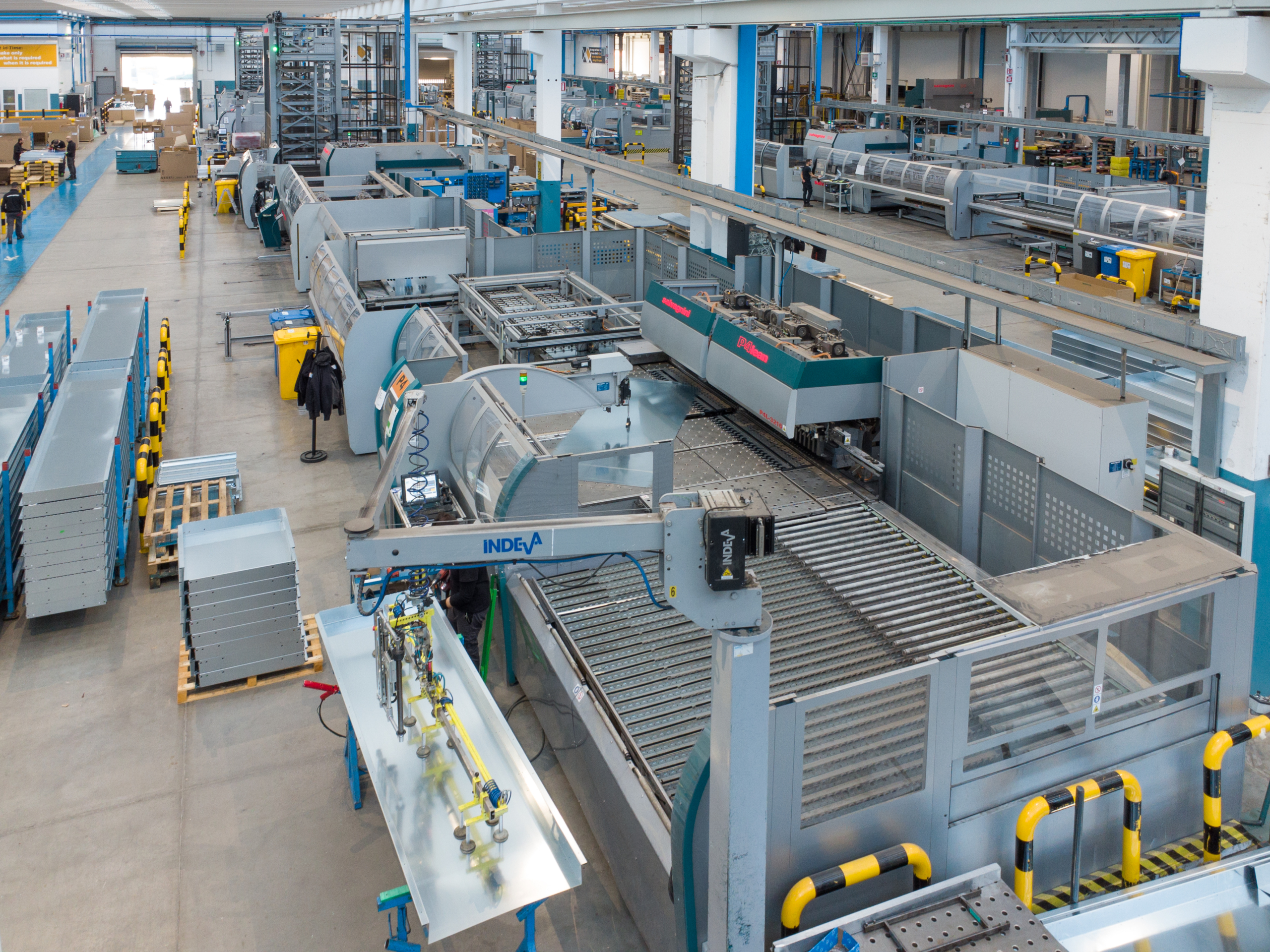
These lines process the raw material directly—1.5 mm sheet-metal coils—which are turned into square blanks in the Novastilmec leveler and, being identical and interchangeable, ensure continuous and perfectly balanced processing. Three of the six lines are dedicated to tray production and three to casing production: highly automated processes capable of ensuring an average capacity of about 350 trays and 500 casings per day per line. The punching and bending lines, followed by immediate boxing of the casings and then robotic welding of reinforcements and automatic assembly of slides on the trays, guarantee consistent quality and reduced lead times.
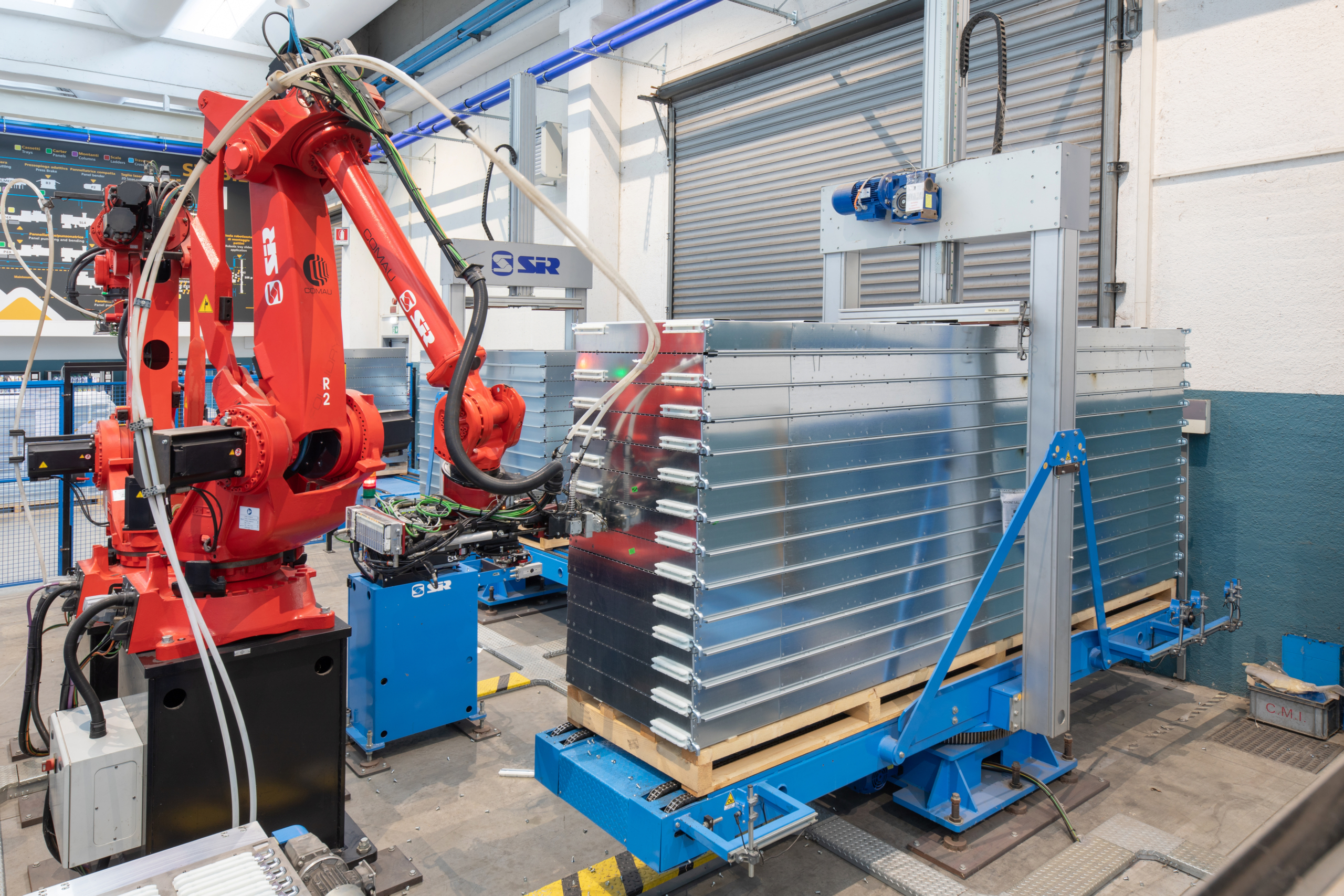
At the heart of this now highly automated process lies a clear entrepreneurial vision, as well as the result of years of collaboration, studies, and continuous exchange between the line supplier and Modula’s production department, which has always aimed to turn digitalization into a true competitive lever.
To further boost production, Modula developed—together with one of its strategic suppliers—an OPS (Operations Planning and Scheduling) software and an MES (Manufacturing Execution System) integrated into the punching, bending, and code-preparation processes. Thanks to this digital infrastructure, today all machines are connected within a single ecosystem. Production orders are processed overnight, and in the morning the operator only needs to check for any anomalies. The entire flow is continuous and immediate: an order can start in the office and be launched into production in real time, without interruptions. Until just a few years ago, the production planning office spent more than half a day processing orders and checking their progress.
Concrete Innovation: Automation, Logistics, and Waste Reduction
The digitalization introduced has generated tangible and easily measurable benefits throughout the entire production process.
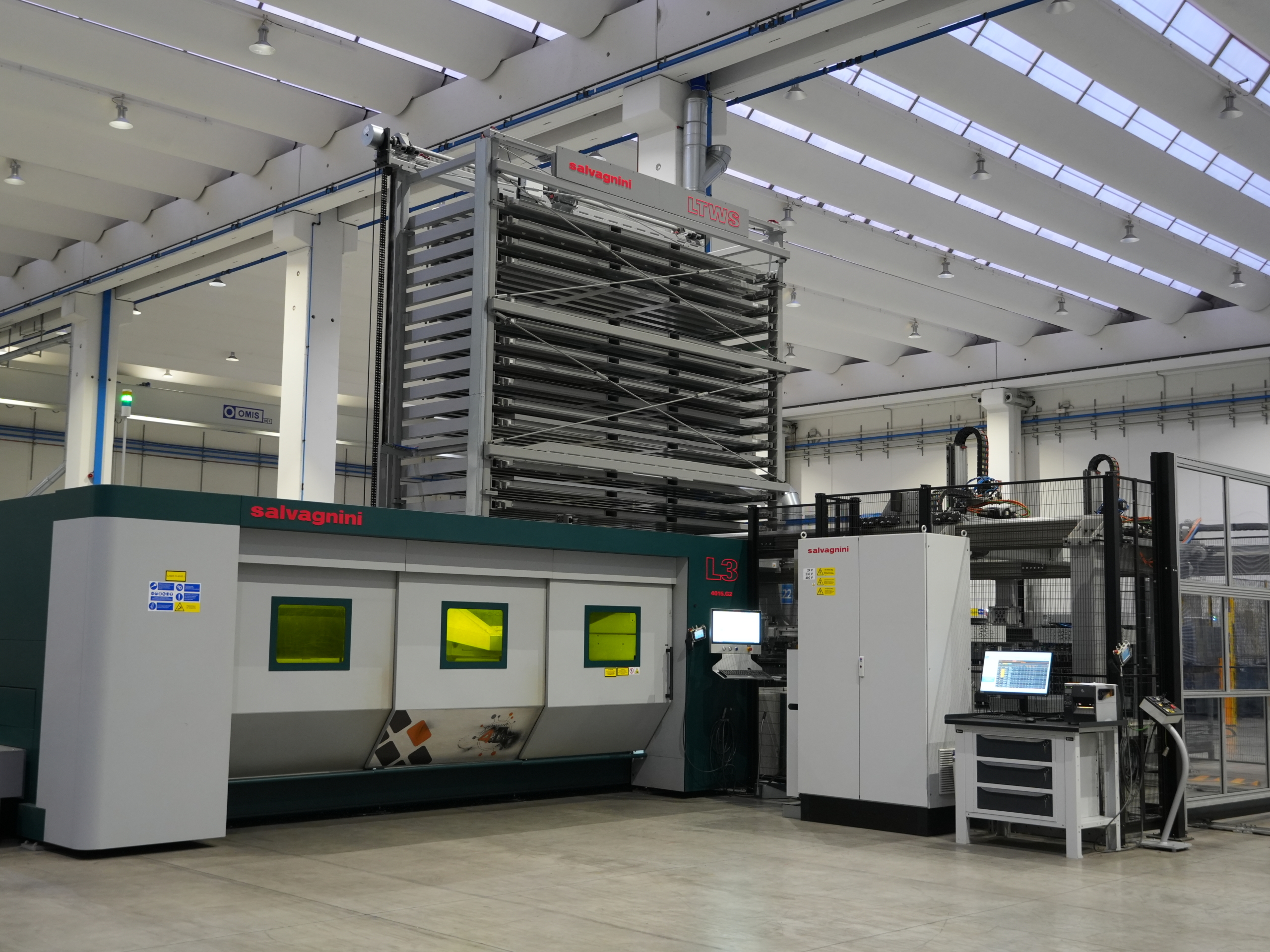
The first area to be transformed was laser cutting, where Modula now operates three L3 systems dedicated to cutting uprights, cross members, side panels, and ladder tracks (key structural elements of Modula): two with manual unloading and one fully automatic. Thanks to this setup, production can reach up to 600 parts over two shifts, with an average time of just 1.5 minutes per part.
The most significant revolution is in bending and panel forming: the combination of a press brake, a panel bender, and two anthropomorphic robots makes it possible to handle and produce up to 630 parts across three shifts, maintaining a cycle time of about 4 minutes per part. A result that would be unattainable without the integration of automation, digital programming, and specialized skills.
From a logistics standpoint, the impact of digitalization is equally evident. Traditional intermediate storage areas have been completely eliminated: today parts come out already finished and organized into “carton pallets,” ready to be shipped or immediately integrated into subsequent phases. Moreover, while casings used to be produced in weekly stock batches, they are now manufactured directly to order, ensuring greater efficiency, flexibility, and waste reduction.
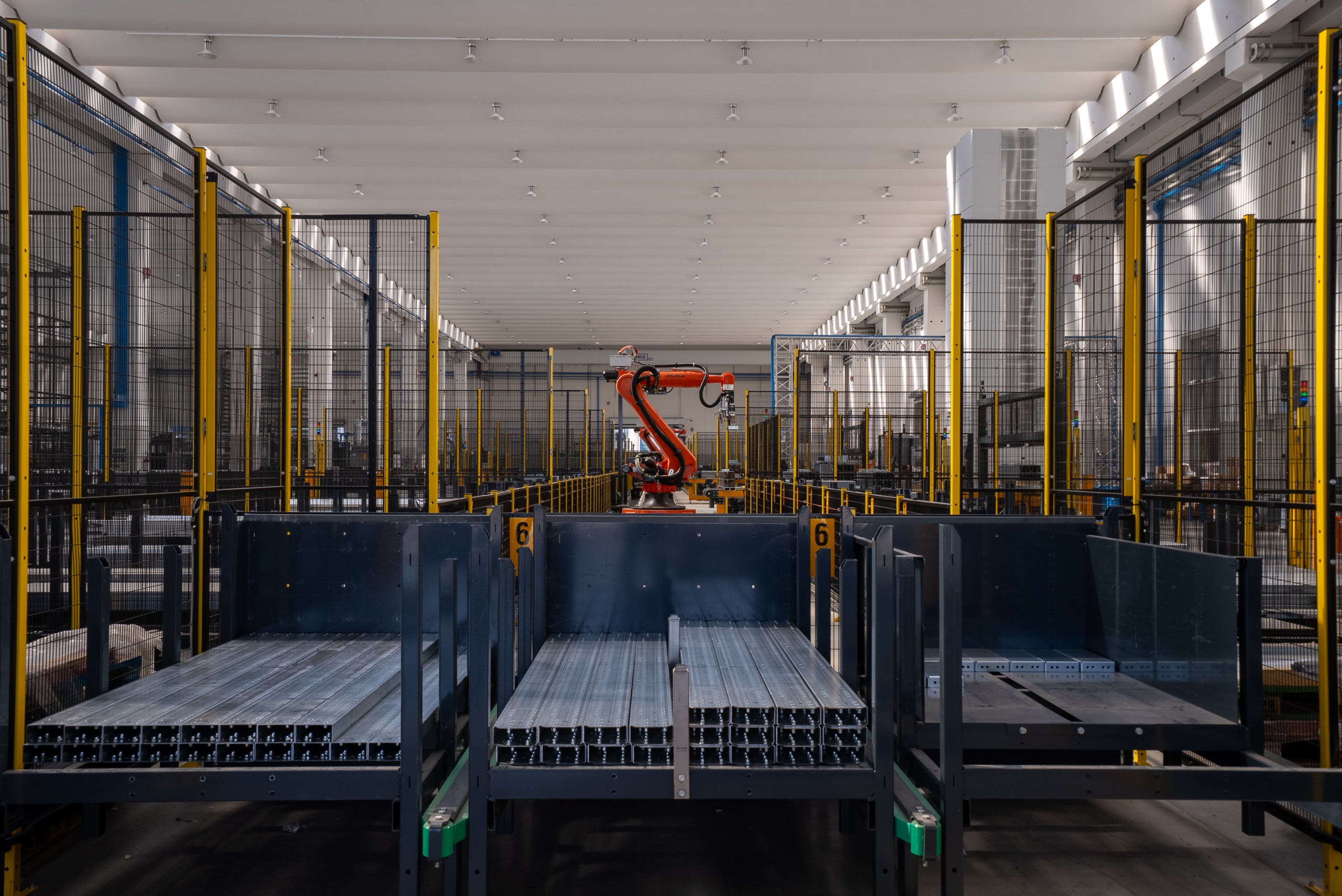
Flow optimization has also affected the handling of the columns (uprights), the load-bearing elements of the Modula structure, which are now stacked and nested vertically to maximize available space and reduce transport costs. All of this is complemented by improved safety and ergonomics: automation has reduced manual handling and has made the work environment safer, more orderly, and more comfortable for operators.
Growth and Results: The Numbers Behind Efficiency
The digital transformation has delivered extraordinary results, visible not only in the technologies adopted but above all in production figures. Today Modula can rely on a strong global capacity: each week about 60 machines are produced in Salvaterra (with the potential to double this output), 15 in the United States, and 8 in China—confirming a scalable industrial model that can be perfectly replicated across its plants worldwide.
The evolution of the Salvaterra plant is particularly significant. In 2010, annual production stood at 410 machines, manufactured with a single welding and bending line and with casings produced to stock. In 2017, thanks to the first structured investments in digitalization, production rose to 1,605 machines per year, and then exceeded 2,000 units in 2018. Looking to the immediate future, in 2025 production reached 2,400 machines, supported by six welding and bending lines and a capacity of 600 parts over two shifts.
Efficiency levels also tell a story of steady growth. From 52% in 2010, efficiency rose to 64% in 2017 and reached 75% in 2024, with a target of 80% by 2026. This improvement has been made possible by smoother processes, smarter technologies, and an increasingly data-driven organization.
The same evolution is reflected in order management times: in 2010, each order required 4.61 hours to process, while by 2024 this had fallen to 3.75 hours, showing how digitalization, advanced planning, and automation have made production not only faster but also far more predictable and stable.
Beyond Technology: a New Industrial Mindset
At Modula, digitalization is not just a technological investment—it represents a true cultural shift.
The latest prototype of a Vertical Lift Module developed in-house at Modula, born from the idea of not wasting even a millimeter of sheet metal, symbolizes this new mindset: designing products with manufacturability and optimization in mind from the very beginning, starting with the process even before the product. This is a product whose tray and casing dimensions were designed based on what can be processed by bending and punching machines, without wasting even a centimeter of material and while optimizing every production step.
This philosophy brings together research and production, engineering and vision, and finds its strength in the quality of partnerships with suppliers. It is not simply a customer–supplier relationship, but a shared journey in which skills, technologies, and know-how converge to create smarter and more sustainable solutions.
Partnership thus becomes a strategic asset: it allows different perspectives to be integrated from the earliest development stages; it accelerates innovation through continuous, structured collaboration; it creates an ecosystem in which every player contributes to the final product quality; and, not least, it makes continuous improvement possible.
In this way, the latest products emerging from R&D are not just prototypes, but the tangible result of a new way of working: joint development, side by side, in which everyone brings the best of their expertise to build the future of manufacturing together.
Conclusion: The Factory as an Intelligent Ecosystem
The Modula case shows that innovation does not simply mean automating—it means deeply rethinking processes to generate value, efficiency, and sustainability.
In a world where markets demand speed, flexibility, and quality, the digitalization of production processes is the key to remain competitive.
Modula has chosen to face this challenge with courage and foresight, transforming its factory into a model of operational excellence and continuous innovation.
A concrete example of how the digital revolution is not just the future of industry, but its most vital present.
Want to know more?