In supply chain operations, efficiency is critical. As order volumes grow and shipping timelines tighten, maintaining clear visibility over available stock becomes more challenging.
In recent years, many organizations shifted toward a “just-in-case” strategy, building up large reserves of inventory to guard against disruptions. However, this approach has proven to be financially heavy.
Recent findings from IHL Group estimate that global inventory imbalance—caused by both shortages and excess stock—costs companies around $1.7 trillion each year.
On top of that, the expenses associated with storing, insuring, and managing inventory typically account for 20% to 30% of its total value annually.
Because of this, keeping large amounts of surplus stock is no longer a viable long-term solution. Warehouse leaders are now expected to optimize operations using fewer resources—less space, lower capital investment, and reduced waste.
This shift is driving renewed interest in more efficient, just-in-time inventory practices.
In this guide, we will:
- Define what just-in-time inventory management actually means
- Explain how it functions in day-to-day operations
- Explore its advantages and potential drawbacks
- Highlight the importance of technology in supporting sustainable JIT strategies in modern warehouses
Understanding Just-in-Time inventory management
So, what exactly is just-in-time inventory?
At its essence, JIT is an approach where materials are ordered, received, and used only when they are required for production or order fulfillment.
Rather than holding large quantities of stock far in advance, this method ensures that goods arrive shortly before they are needed—often within hours or days—reducing the need for extensive storage.
To fully understand JIT, it’s helpful to distinguish between “push” and “pull” systems.
Traditional warehouse models follow a push system, where production is based on forecasts and goods are stored in advance.
In contrast, JIT operates on a pull system, where production and replenishment are driven by actual demand.
This concept was pioneered by Toyota through its Production System (TPS), with the goal of eliminating waste (known as “muda”) by maintaining minimal inventory levels.
In an optimal JIT environment, materials arrive and are immediately used in production, without sitting idle in storage.
How Just-in-Time inventory works
Just-in-time inventory management is based on a demand-driven (pull) model, meaning production and replenishment only occur when there is a real need.
Instead of depending entirely on forecasts, this system reacts to real-time triggers—such as customer orders, completed production steps, or warehouse picking confirmations.
A typical JIT workflow includes:
- Order initiation: a customer order is placed, or an internal process signals a requirement (for example, a workstation running low on components).
- Pull signal activation: this need generates a digital request—often through a warehouse management system (WMS)—which is sent upstream to suppliers or receiving teams.
- Targeted fulfillment: only the exact quantity required is shipped or picked, ensuring accuracy and minimizing excess.
- Direct flow: upon arrival, goods are immediately directed to production or shipping, reducing or eliminating storage time.
Just-in-Time (JIT) vs. Just-in-Case (JIC): Main Differences
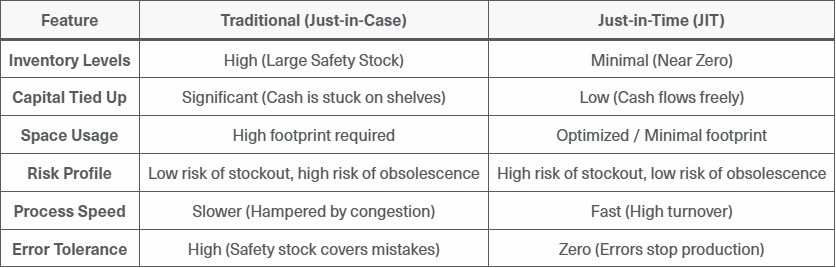
Inventory strategies are often compared through the lens of JIT versus JIC.
The just-in-case approach prioritizes maintaining extra stock as a safeguard, while just-in-time focuses on minimizing inventory and improving precision to enhance financial performance.
- Just-in-time systems: Inventory is ordered only when demand is confirmed. This reduces stock levels, freeing up capital and warehouse space.
- Just-in-case systems: Large amounts of safety stock are kept to handle uncertainties like supply chain disruptions or sudden demand spikes.
While JIC provides a cushion against risk, it comes with significant carrying costs. JIT eliminates much of this overhead but requires highly accurate and responsive operations to prevent stock shortages.
Modern logistics is increasingly moving toward hybrid models. However, for companies aiming to remain competitive in both cost efficiency and operational speed, adopting a just-in-time inventory approach remains essential.
The main difficulty lies in controlling risk—this is where real-time visibility and automation become critical factors.
Dynamic buffering vs. Safety stock: understanding the difference in JIT systems
A widespread misunderstanding is that just-in-time inventory means operating with no inventory at all. In reality, successful JIT strategies rely on buffer storage, which is fundamentally different from safety stock.
Safety stock refers to extra inventory kept as a precaution against external uncertainties such as supplier delays, transport disruptions, or sudden spikes in demand.
Although useful in certain cases, this approach contradicts the core principle of JIT, which is to reduce excess inventory and reveal inefficiencies rather than conceal them.
Buffer storage, by contrast, is designed to handle internal variability within operations. In everyday workflows, processes are rarely perfectly synchronized—some stations may operate faster than others or experience short interruptions.
Without a buffer, even minor disruptions can ripple through the system and halt downstream processes.
A properly controlled buffer provides a limited, temporary cushion that absorbs these fluctuations without reverting to overstocking. When implemented effectively, it supports continuous flow while staying aligned with JIT principles.
Automation further enhances this approach. Technologies such as Vertical Lift Modules (VLMs) can function as dynamic work-in-progress buffers by storing temporary inventory vertically. This not only frees up floor space but also reduces handling risks while improving visibility and control.
When managed correctly, buffer storage doesn’t weaken just-in-time systems—it actually reinforces them, enabling smoother operations and greater adaptability in modern fulfillment environments.
How to implement Just-in-Time inventory management
Transitioning to a just-in-time model is not an overnight shift. It typically involves a phased and structured approach.
Rather than immediately cutting inventory levels, organizations gradually improve reliability, visibility, and responsiveness across their operations.
Key steps in this transition include:
- Verify inventory accuracy through physical checks
Before reducing stock, companies must ensure their inventory data is reliable. Without an accurate baseline, JIT increases the likelihood of shortages and disruptions. - Study demand trends and variability
A clear understanding of demand patterns is essential. High-volume or predictable items are usually the first to be managed under JIT, while more volatile products may require alternative strategies. - Coordinate with suppliers for frequent, smaller deliveries
Strong supplier alignment is crucial. JIT requires shorter lead times and more frequent replenishment cycles, often involving renegotiated agreements and service expectations. - Streamline internal processes and reduce inefficiencies
Internal workflows—such as receiving, storage, picking, and movement—directly impact JIT performance. Eliminating unnecessary handling, optimizing picking routes, and reducing search time ensures materials are available exactly when needed. - Assess whether systems and layouts can handle higher activity levels
Even if total volume remains unchanged, JIT increases transaction frequency. Warehouses must evaluate whether their infrastructure, storage systems, and software can support faster operations without sacrificing accuracy.
Advantages of Just-in-Time inventory management
Organizations adopt JIT because it delivers measurable returns across several areas:
- Lower holding costs
Expenses related to storage, climate control, insurance, depreciation, and security typically represent 20–30% of inventory value annually. JIT significantly reduces these costs. - Improved cash flow
Purchasing goods only after confirming demand shortens the cash conversion cycle and prevents capital from being tied up in unsold inventory. - Better use of warehouse space
Reducing excess stock frees up valuable space, allowing for expansion of operations or the introduction of new products without increasing facility size. - Reduced risk of obsolescence
In fast-moving industries like electronics, fashion, and automotive, products lose value quickly. JIT helps ensure items are used or sold while still relevant. - Enhanced quality control
With lower inventory levels, defects are identified sooner—either upon arrival or during use—rather than being discovered much later.
Risks and challenges of Just-in-Time systems
Despite its advantages, JIT comes with important considerations:
- Increased vulnerability to supply chain disruptions
With minimal safety stock, delays or issues from suppliers can immediately impact operations. - Greater sensitivity to internal errors
Mistakes such as incorrect picking or misplaced items have a more direct and disruptive effect in a lean inventory environment. - Higher coordination and handling demands
Frequent, smaller deliveries require well-organized receiving and putaway processes. Without them, handling costs may offset savings. - Dependence on accurate data and visibility
JIT requires precise inventory records and reliable systems. Even minor discrepancies can lead to stockouts or delays. - Need for operational maturity
Successful implementation depends on disciplined processes, dependable suppliers, and aligned systems. Without these, JIT risks exposing weaknesses instead of delivering efficiency.
For this reason, just-in-time should be viewed not simply as a cost-reduction tactic, but as a strategic approach that requires strong operational foundations, robust systems, and reliable partnerships.
The constraints of manual warehousing in a JIT environment
As order volumes increase and batch sizes become smaller, manual warehouse operations begin to show their limitations.
Long travel distances, time spent searching for items, and reliance on manual verification processes become increasingly inefficient when workflows shift from large, infrequent picks to frequent, smaller ones.
Within a just-in-time inventory framework—where buffers are kept to a minimum—maintaining both speed and accuracy becomes more challenging. As a result, many organizations begin to reconsider their processes or introduce automation to keep operations efficient.
How automation enhances Just-in-Time inventory systems
When inventory buffers are reduced, there is less room for operational variability. For this reason, companies implementing JIT often rely on automation to ensure consistent and stable warehouse performance.
Technologies such as automated storage and retrieval systems (AS/RS)—including Vertical Lift Modules (VLMs) and horizontal carousels—are widely adopted to improve visibility, execution speed, and consistency.
Here’s how Modula solutions contribute to JIT operations:
- Real-Time integration with business and warehouse systems
JIT relies on fast and accurate demand signals. When materials are consumed or orders are released, those signals must quickly translate into warehouse activities.
Modula’s warehouse management system (WMS) integrates with ERP platforms to provide real-time inventory tracking and full traceability—both essential for JIT execution.
When a production order is issued, the system immediately converts it into a picking task, reducing delays between demand signals and warehouse actions while keeping inventory data synchronized across the organization.
- Reliable performance in high-frequency picking
JIT increases the number of warehouse transactions, even if total inventory levels decrease. Orders become smaller but more frequent.
Instead of handling large batch picks, warehouses must execute continuous, smaller picking activities throughout the day.
Modula Lift VLMs support this model by delivering goods directly to operators (“goods-to-person”), significantly reducing walking time and helping maintain consistent productivity—crucial for avoiding downstream delays.
- Higher accuracy and inventory dependability
With minimal safety stock, even small errors can have immediate consequences. Incorrect picks, misplaced items, or quantity mismatches can disrupt production or delay shipments.
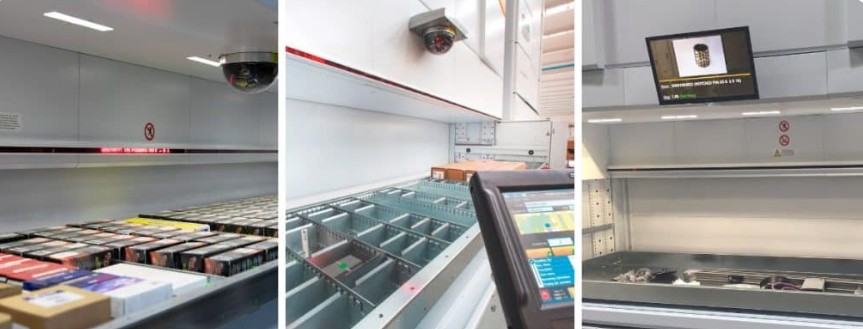
Automation improves accuracy by guiding operators to the correct items and quantities while recording every transaction digitally.
Modula systems use visual aids such as laser pointers and alphanumeric indicators to support precise picking, significantly reducing human error and ensuring reliable inventory control even at lower stock levels.
- Controlled access and secure operations
In JIT environments, maintaining control over inventory is just as important as speed.
Modula systems monitor user access and track all picking and replenishment activities at the tray level. This prevents duplicate picks, unauthorized handling, and loss of valuable items, while also reducing the administrative effort required to resolve discrepancies or investigate errors.
- Space optimization and flexible storage design
JIT requires inventory to be stored close to its point of use while minimizing space consumption.
Modula VLMs maximize vertical space, allowing a large volume of items to be stored within a compact footprint. This reduces internal travel distances and brings materials closer to production or fulfillment areas.
Their modular structure allows for height adjustments over time, adapting to changes in facility layout. Trays can be customized with dividers to match specific item dimensions, and configurations can be modified as product ranges evolve.
This adaptability supports consistent performance even as inventory needs change.
When a JIT strategy is the right fit
Just-in-time inventory management is particularly effective in the following scenarios:
- High-value products: where holding costs are significant
- Fast-moving items: with stable and predictable demand
- Limited warehouse space: when expansion is not feasible
- Assembly operations: where components are required in sequence (Just-in-Sequence)
When JIT may not be suitable
On the other hand, a pure JIT approach may not be ideal in situations such as:
- Highly unpredictable demand: sudden spikes make it difficult to respond quickly
- Long supplier lead times: extended delivery timelines require buffer stock
- Low-cost consumables: the effort to optimize flow may outweigh the benefits
Key takeaways on Just-in-Time inventory management
- JIT is a strategic approach, not a fixed formula
It delivers results only when supported by reliable processes, accurate data, and strong supplier coordination. - Lower inventory is the outcome, not the starting point
Improved flow and synchronization naturally lead to reduced stock levels. - Buffer storage and safety stock are not the same
While JIT minimizes excess inventory, controlled buffers are still necessary to manage internal variability. - Technology plays a critical role in scalability
As transaction volumes increase and buffers shrink, automation ensures visibility, speed, and accuracy. - JIT works best as part of a broader strategy
For many organizations, it is one element of a long-term effort to balance efficiency, resilience, and growth.
Frequently asked questions about JIT inventory management
What is just-in-time inventory?
It is a system where materials and products are received and used only when needed. Instead of storing large quantities in advance, items arrive shortly before use, reducing storage requirements.
What is the main risk of JIT?
The biggest risk is supply chain disruption. With minimal buffer stock, delays or issues from suppliers can quickly affect production.
Does JIT mean zero inventory?
No. JIT focuses on maintaining only the necessary level of inventory to ensure smooth operations, not eliminating stock entirely.
Is automation required for JIT?
Not strictly, but it becomes increasingly important as operations scale. Automation helps maintain speed and accuracy with higher transaction volumes.
Can small businesses use JIT?
Yes. JIT principles can benefit companies of all sizes by improving cash flow and reducing inventory-related costs.
The advantages of a Modula automatic vertical storage system