A warehouse may appear efficient without actually being so. The difference between perception and certainty lies in the data: until space, time, and movements are measured, every decision is based on intuition. A warehouse KPI — Key Performance Indicator — helps bridge this gap by turning day-to-day operations into figures that can be compared over time and, above all, acted upon.
In practice, the problem is rarely a lack of data, but rather its quality. Many companies measure KPIs manually, using spreadsheets that are updated infrequently, or collect indicators that are never translated into decisions.
The result is the same: the most expensive inefficiencies often remain invisible until they become an obvious cost.
What Are Warehouse KPIs and Why Are They Important?
Warehouse KPIs, also known as warehouse key performance indicators, are metrics used to measure the effectiveness, efficiency, and overall performance of a warehouse or distribution center.
They are essential tools because they provide an objective view of every operational stage, from goods receiving to shipping, helping companies identify critical areas, make informed decisions, and optimize warehouse logistics.
Monitoring them continuously provides tangible benefits in four areas:
- Performance assessment: they provide a clear picture of how the warehouse is operating and where bottlenecks are concentrated.
- Inventory optimization: monitoring turnover and carrying costs helps maintain appropriate stock levels and avoid tying up unnecessary capital.
- Data-driven decisions: decisions regarding layout, staffing, and investments are based on concrete data rather than perceptions.
- Cost reduction: identifying inefficiencies makes it possible to intervene before they turn into financial waste.
But what happens when KPIs are not measured, or are measured incorrectly?
This is where the most difficult-to-detect inefficiencies tend to hide, because they often appear in no report at all: material obsolescence, operator idle time, and picking errors that result in customers receiving the wrong, damaged, or expired product.
These are real costs that remain hidden precisely because no one is measuring them.
The first benefit of a good KPI system is therefore to make visible what a company would otherwise be paying for without realizing it.
How to Choose the Right KPIs for Your Warehouse
Not all KPIs carry the same weight.
An e-commerce warehouse, where order fulfillment speed and returns management are critical, will have different priorities from a warehouse in the aerospace sector, where picking accuracy is critical by definition.
The size of the facility and the company’s specific objectives also influence the selection.
A good prioritization rule is to start with a small number of indicators that are truly critical for your industry, measure them consistently, and expand the set only once the collected data is reliable and actually being used.
A useful selection process can follow four steps.
The first is to start from your objectives. Reducing costs, increasing capacity, or improving customer service all require different KPIs, so it makes sense to choose the ones that directly measure the result you want to achieve.
The second is to identify the bottleneck, meaning the area where the most time and resources are being lost. In most warehouses, this is picking, so the first indicators should focus there.
The third step is to make sure that every KPI is actionable. If a number does not lead to a decision or an action, it is simply another piece of data to collect rather than a useful indicator.
The fourth is to start with what can be measured reliably using the tools already available, expanding the KPI set only when the data collected is solid and genuinely being used.
To make the selection objective, a clear starting point is needed.
During the analysis phase, Modula technicians rely on the European industry standard FEM and use an internal application to estimate warehouse efficiency and compare it with the potential achievable scenario.
The tool provides a snapshot of the warehouse’s current situation, including energy consumption and picking times, and compares it with the scenario that could be achieved by adopting the selected Modula system.
This provides an objective and quantified benchmark before any changes are introduced.
What Are the KPIs of a Warehouse? The Main Indicators by Operational Area
Each stage of the logistics flow has its own indicators, and some areas are more important than others depending on the industry.
There is no need to monitor all these indicators at the same time.
The following list includes the main metrics used in warehouse operations. They should be selected according to the industry, business objectives, and critical issues that need to be addressed.
Goods Receiving KPIs
Receiving includes unloading, documentation, inspection, quality checks, and labeling of incoming goods.
It is an especially important area for companies handling high inbound volumes or perishable goods, where receiving speed and accuracy affect the entire downstream flow.
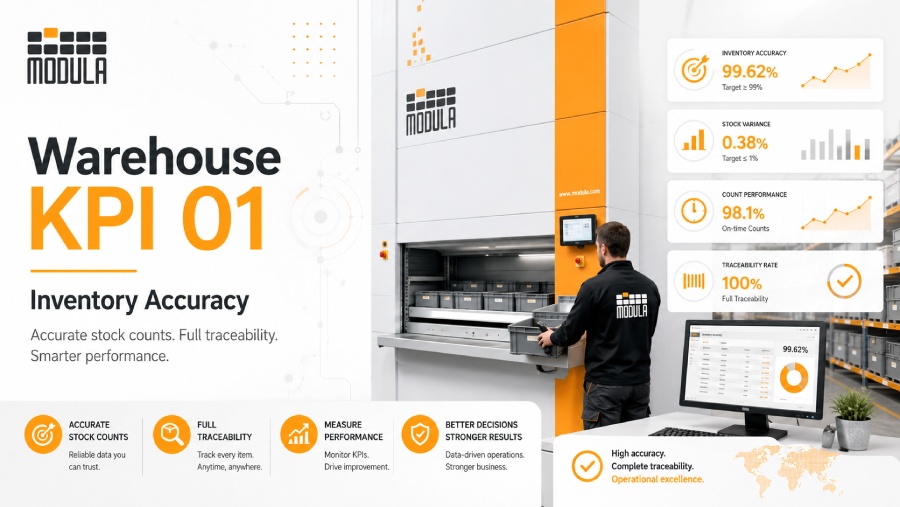
- Receiving accuracy: measures the percentage of received goods that match the purchase order. Correct items received ÷ Expected items × 100. A low value means that the inventory is already inaccurate at the inbound stage, causing every subsequent process to work with distorted data.
- Receiving cycle time: measures how much time passes between the arrival of goods and their availability in storage. Total sorting time ÷ Number of items received
Storage KPIs
Storage determines how products are organized and kept.
It is a priority area because it concentrates two costs that are often underestimated: space and capital tied up in inventory.
This is particularly relevant in warehouses with many slow-moving SKUs and a high value of stock sitting idle.
- Inventory carrying cost: represents the total cost associated with storing inventory. Total inventory ÷ Total warehouse value × 100
- Storage productivity: evaluates the efficiency of storage processes, measured as the volume of inventory stored per square meter. Occupied space ÷ Total storage capacity × 100
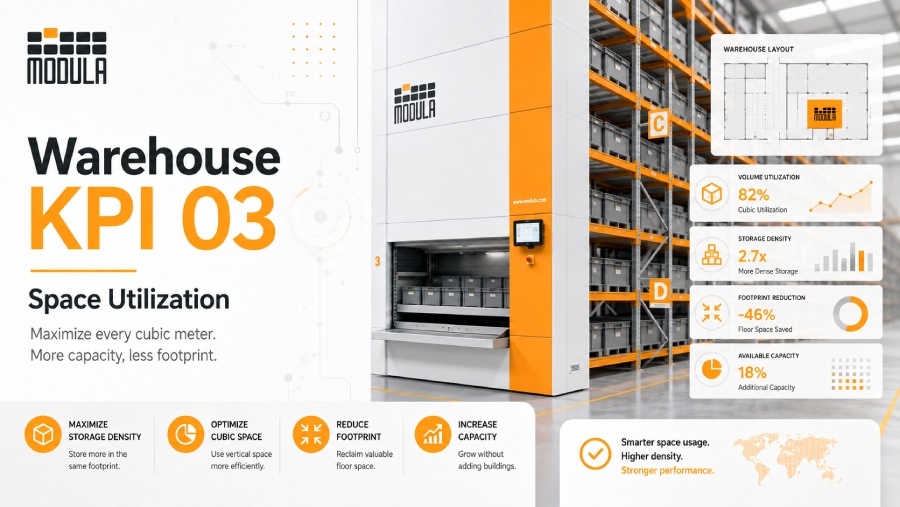
- Storage space utilization: measures how efficiently the warehouse uses the available space. Occupied space ÷ Total usable space × 100
- Inventory-to-sales ratio: compares available inventory with sales, helping identify demand trends. Inventory value ÷ Sales volume over a given period
Picking KPIs
Picking is the process of selecting and retrieving goods from storage locations according to order requirements.
It is the area where many warehouse inefficiencies are concentrated and, at the same time, the area with some of the greatest opportunities for improvement.
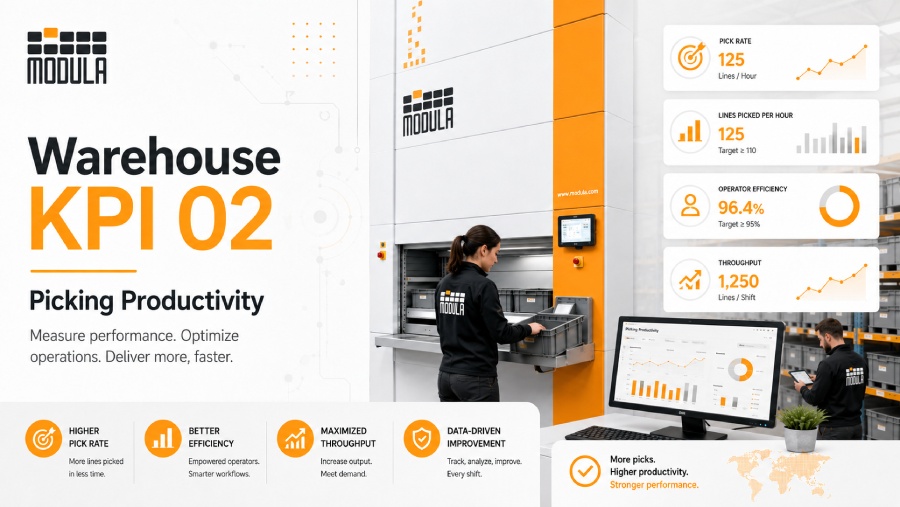
- Picking productivity: measures the number of order lines picked per hour and exposes a major hidden source of waste: the time operators spend walking between shelves instead of picking. Lines picked ÷ Hours spent picking
- Picking accuracy: measures how accurately the correct SKU is picked and directly affects returns and rework costs. Orders fulfilled correctly ÷ Total orders × 100
- Picking cycle time: measures the time required to complete the picking of an order, from the moment the order is received until it is ready for shipment. Picking start time − Picking end time
Distribution and Shipping KPIs
Distribution manages the movement of inventory from the warehouse to its final destination.
These KPIs are directly perceived by the end customer and have a direct impact on service reputation.
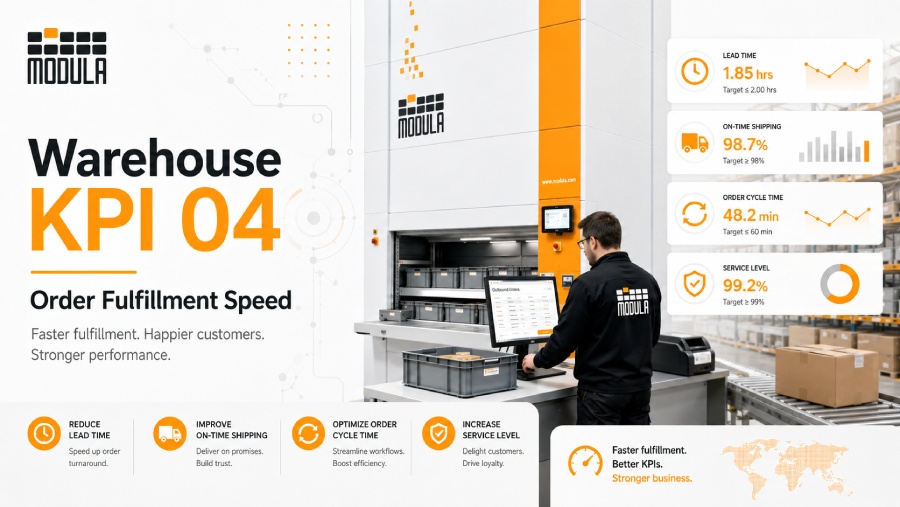
- Order lead time: measures the time between receiving an order and its arrival at the customer, including processing, picking, packing, and shipping. Order entry time − Order fulfillment time
- Perfect order rate: measures the percentage of orders fulfilled without errors or delays. Perfect orders ÷ Total orders × 100
Reverse Logistics KPIs
Reverse logistics manages the flow of goods from the customer back to the warehouse for returns, repairs, recycling, or disposal.
It is particularly important in the e-commerce sector.
- Return rate: measures the percentage of shipped orders that are returned. Returned orders ÷ Shipped orders × 100. A high return rate is often a sign of upstream problems, particularly with picking accuracy.
- Return processing time: measures the time between receiving a returned product and the point at which it is ready for resale or disposal. Return receipt time − Process completion time
Safety and Workforce Productivity KPIs
This area combines two dimensions that influence one another: how efficiently labor is used and how safe the working environment is.
It is particularly relevant in labor-intensive operations, where personnel costs and safety have a greater impact on the income statement.
- Lost time due to injuries: measures the number of working hours lost because of accidents or injuries. Hours lost due to injury ÷ Total scheduled hours during the period × 100
- Labor utilization: measures how much of the available working time is used productively. Actual working hours ÷ Available hours × 100. This indicator makes visible the idle time that rarely appears in reports but still has a significant impact on labor costs.
The Priority KPIs to Monitor First
Not all indicators need to be introduced immediately.
However, if you are looking for a universal starting point, the most useful KPIs for warehouse efficiency are relatively few and apply across different operations.
Among the most relevant warehouse KPI examples are two picking metrics: accuracy, because one picking error can result in returns and downstream costs, and productivity, because picking is one of the processes most vulnerable to inefficiency.
These can be combined with storage indicators that help monitor space and capital, including space utilization and inventory carrying costs.
It is also worth introducing two indicators from the beginning that very few companies monitor but that can reveal some of the most expensive inefficiencies: material obsolescence and operator idle time.
These often have a greater impact on margins than more traditional KPIs.
How Automation Improves Warehouse KPIs
A warehouse can only be improved if it is measured.
KPIs turn space, time, inventory, and movements into comparable figures and provide the basis for sound logistics decisions rather than intuition.
This is where automation makes a difference: it not only measurably improves key indicators, but also makes data collection automatic, accurate, and continuous.
A Vertical Lift Module completely changes the logic of picking: instead of the operator going to the goods, the goods are brought to the operator.
This directly affects several of the indicators discussed above.
The most measurable effects are concentrated in the areas where customers are likely to notice improvements first:
- Picking time and productivity: unnecessary movement and searching are eliminated.
- Picking accuracy: visual aids guide the operator to the exact item, reducing picking errors.
- Space utilization: a system such as Modula Lift uses vertical height to recover floor space and improve overall space utilization.
- Inventory carrying costs: these are reduced through accurate traceability of every movement, limiting obsolescence and inventory discrepancies.
From a measurement perspective, Modula’s WMS — Warehouse Management System — software automatically generates reports on material turnover and picking activity.
As a result, warehouse management KPIs linked to these areas no longer depend on manual, periodic data collection. Instead, they become part of a continuous and up-to-date flow of information.
FAQ About Warehouse Management KPIs
What Are the Main KPIs in a Warehouse?
If you are starting from scratch, it is best to focus on a small number of genuinely useful indicators.
Picking accuracy and productivity help identify operational errors and inefficiencies quickly, while space utilization and inventory carrying costs help evaluate storage effectiveness.
Once the measurement system is established, the number of monitored KPIs can gradually be expanded.
How Often Should Warehouse KPIs Be Monitored?
The frequency depends on the type of indicator and the company’s objectives.
Operational indicators related to picking and productivity benefit from continuous or daily monitoring, while metrics such as inventory turnover or carrying costs are typically evaluated weekly or monthly.
The decisive factor is not the frequency itself, but the availability of reliable and up-to-date data.
Real-time monitoring systems make it possible to address critical issues before they turn into costs.
40 Warehouse KPIs to monitor and measure performance