Intralogistics efficiency and energy savings are now central to the optimization of business processes, as they help reduce waste, consumption and operating times while improving productivity and flow control.
Intralogistics efficiency no longer depends on a single technology, but on the ability to make different systems communicate within a coordinated flow. This is where the Vertical Lift Module becomes much more than a storage solution: it becomes an intelligent node within a broader ecosystem, where handling, picking and internal transport are connected and digitalized.
In this scenario, Modula is not just a system for optimizing space and speeding up picking operations. Thanks to Modula WMS software, it can integrate with anthropomorphic robots, manipulators, conveyors, AMRs, AGV systems, picking stations, traditional warehouses and, in the case of Modula Long Goods and Modula Pallet, also with forklifts and dedicated handling equipment. The result is smoother, more accurate logistics that are easier to manage.
From Standalone Automation to an Integrated Ecosystem
Many companies have already introduced automation elements into their facilities, but the real step change happens when these elements stop operating separately and start exchanging data, missions and priorities in real time.
This is precisely the key point: automating a single phase is not enough. Receiving, storage, picking, internal transport, line replenishment and order preparation must be connected. In other words, integration is needed.
One of Modula’s added values lies in its ability to fit into this logic. The VLM can communicate with different technologies and become an active part of a continuous process, where every movement is orchestrated by Modula WMS software according to the operational needs of the specific context.
Modula WMS as the Director of the Entire System
Software is the true enabler of this integration. Modula WMS does not simply manage picking and replenishment operations inside the VLM; it coordinates data, locations, missions, stock levels and flows throughout the entire process.
Modula WMS makes it possible to have a unified view of the ecosystem: it knows, at any given moment, where the material is, who is handling it, what priority it must be managed with and where it needs to be sent, connecting directly to the internal supply chain.
Centralized management delivers very concrete benefits:
- complete traceability
- synchronization between different technologies
- fewer errors
- better space utilization
- greater operational continuity
In addition, the same software environment can also be extended to manual areas and traditional warehouses, creating a single control system even in hybrid contexts.
Integration with Robots and Manipulators: Automating Picking and Replenishment
Among the most advanced integrations are those with anthropomorphic robots, cobots and manipulators. In these applications, Modula becomes the robot’s automatic supply point, enabling it to perform picking, depositing, kit preparation or line-feeding operations.
The benefit is clear: the robot carries out repetitive or high-frequency tasks, while the VLM brings the material to the bay according to the “goods-to-person” logic or, in this case, “goods-to-robot.” The result is a more stable, continuous and precise process, particularly suited to production environments where reliability, repeatability and 24/7 availability are required.
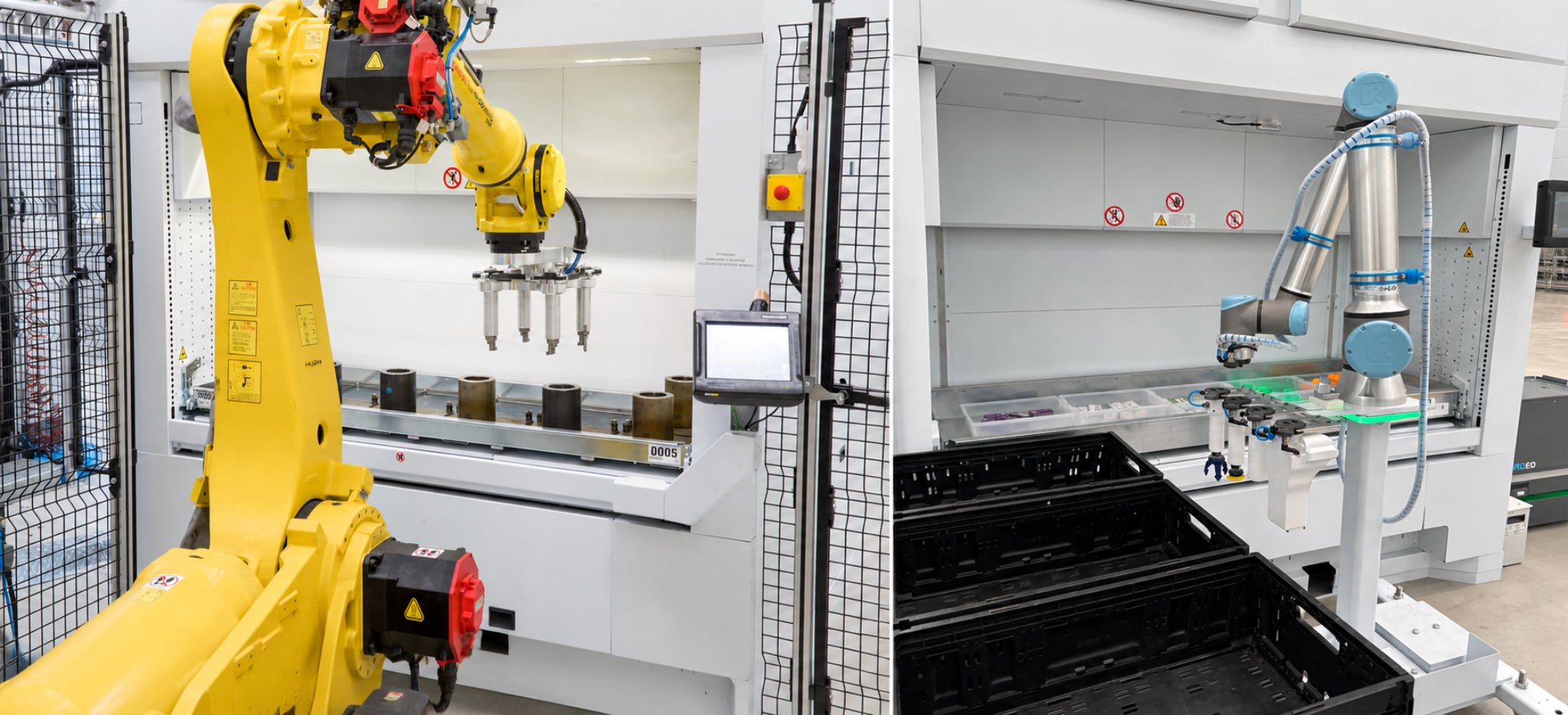
This type of integration is especially interesting when managing small components, assembly items, individual parts or high-intensity flows. The robot can pick directly from the tray of the Modula VLM and transfer the material to production or to the next workstation, even reaching inaccessible or hazardous areas, without interruptions and with a drastic reduction in manual activities.
Conveyors and Roller Conveyors: Flow Continuity Between Storage and Process
Conveyor systems remain a highly effective solution for transferring materials between fixed points in the warehouse or production area. Belts, roller conveyors, pallet lines and motorized routes make it possible to maintain a constant and predictable flow, especially when layouts are stable and volumes are high.
When integrated with conveyors and roller conveyors, the Modula VLM can automatically supply picking areas, workbenches, packaging stations, shipping areas or production lines. Material leaves the VLM and is transferred seamlessly to the next phase, reducing intermediate steps and downtime.
This integration is particularly useful when containers, bins, packages or pallets need to be moved along recurring routes. Conveyors are ideal for fixed and repetitive connections, while Modula WMS coordinates missions, assigns priorities and synchronizes flows with the rest of the plant.
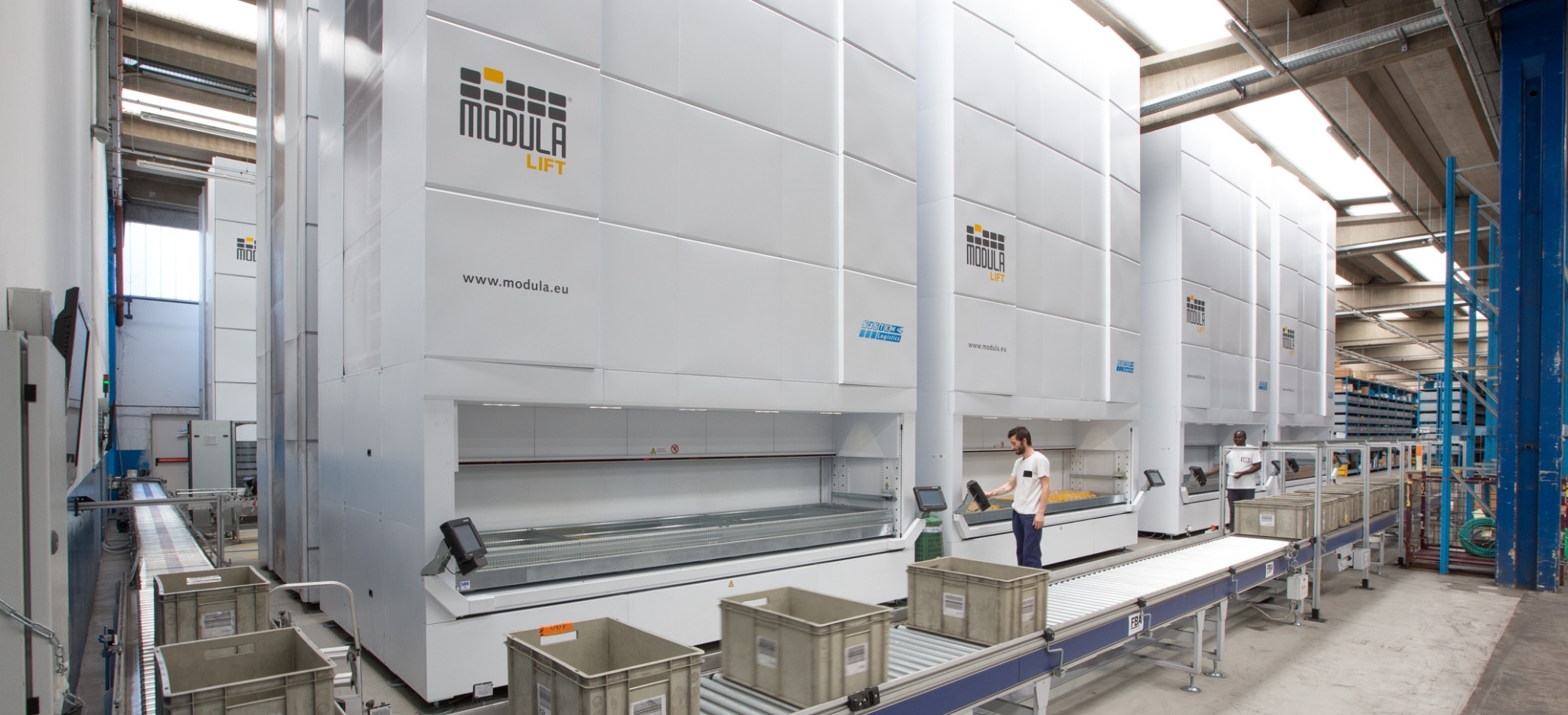
The key point, however, is not choosing between Modula and conveyors: it is making them work together. The VLM manages intelligent storage and controlled picking, while the conveyor ensures the linear transport of materials between the different operational areas.
AMRs: Dynamic Flexibility for Changing Logistics
When the layout is dynamic, spaces are shared or routes need to adapt to operational changes, autonomous mobile robots, or AMRs, are a particularly effective solution. AMRs move autonomously, avoid obstacles, optimize routes and can serve different departments without requiring invasive fixed infrastructure.
Integrated with Modula, AMRs pave the way for extremely flexible automation. They can collect materials from the VLM and deliver them to lines, benches, work islands, hazardous areas, consolidation areas or other technologies within the facility, 24/7. Likewise, they can collect materials from various areas and convey them to Modula for storage or replenishment.
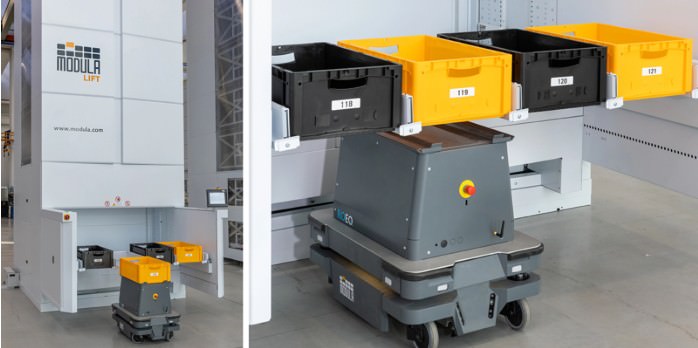
This approach is ideal for companies that want to grow step by step without having to completely redesign their layout. AMRs with Modula can be implemented in a modular, fast and scalable way, and the fleet management software can communicate with Modula WMS to activate automatic missions based on real events: an urgent request, a minimum stock threshold, a replenishment mission or an order to be completed.
In practice, the Modula VLM becomes an intelligent source of material, while AMRs extend its reach throughout the factory or logistics center.
AGV Systems: Guided Automation for Repetitive and Structured Missions
Alongside AMRs, or Autonomous Mobile Robots, AGV systems, or Automated Guided Vehicles, also play an important role in many industrial contexts. Compared with autonomous robots, AGVs follow more structured and predefined routes using:
- Magnetic tapes or QR codes on the floor: AGVs follow a route physically marked on the floor with tapes, lines or QR codes.
- Laser sensors or machine vision: AGVs use lasers or cameras to navigate the environment by recognizing reflectors or landmarks. Routes can be modified via software.
- More advanced autonomous navigation systems: AGVs create a map of the environment, use sensors and move autonomously while avoiding obstacles. This allows them to adapt in real time to operating conditions.
As a result, they are particularly suitable when flows are stable, routes are recurring and the goal is to standardize internal transport.
Integrating the Modula VLM with an AGV system means connecting automated storage to planned and repeatable handling missions: transport to production, transfer to buffer areas, feeding of specific workstations and movement of materials between receiving and storage.
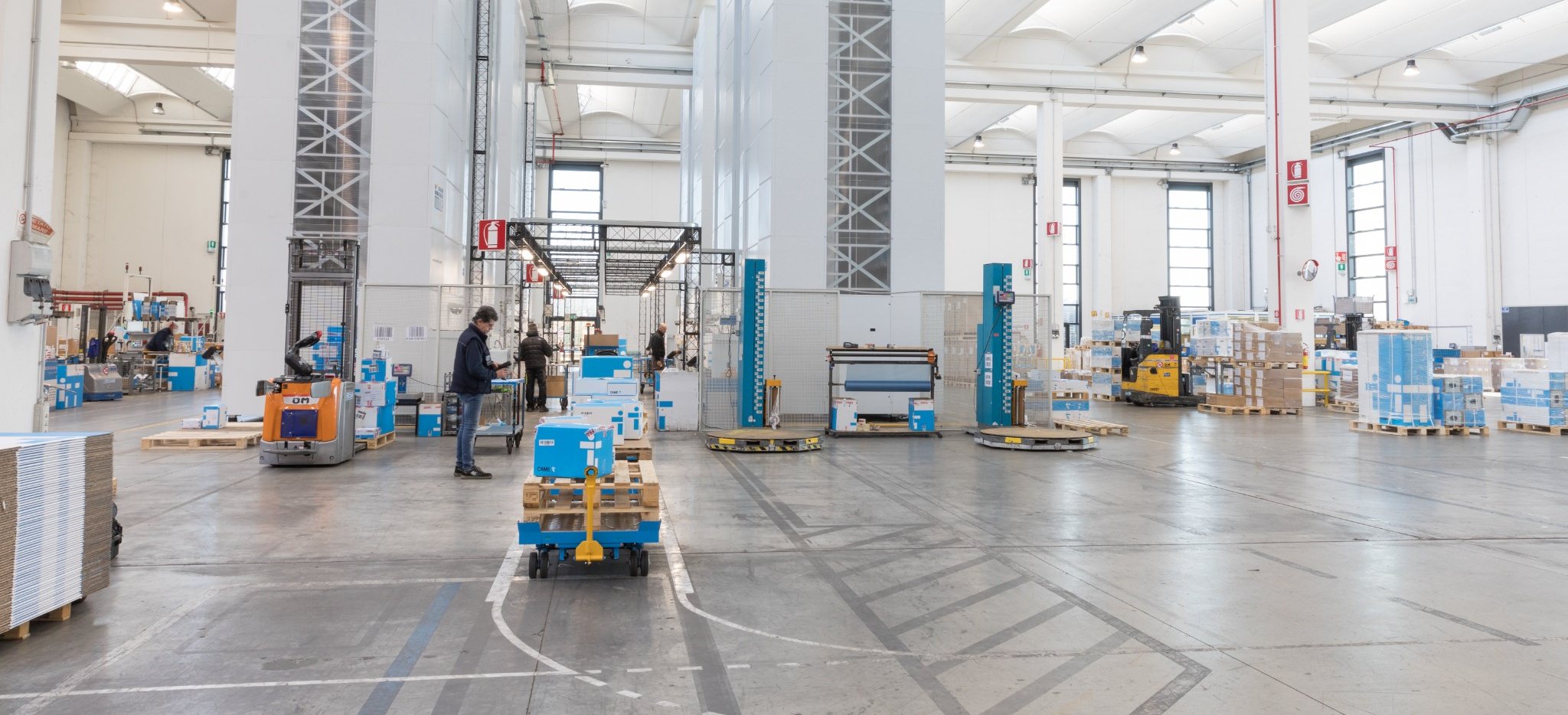
Here too, the value does not lie in the simple physical connection, but in information synchronization. Modula WMS coordinates requests, priorities and destinations, allowing AGVs to move as part of a broader process rather than as isolated vehicles.
Modula Long Goods and Modula Pallet: When Forklifts and Dedicated Equipment Come Into Play
Not all load units are suited to the same level of automation. Heavy pallets, finished or semi-finished products, out-of-gauge materials or bulky items often require dedicated management, where automated systems such as Modula Long Goods and Modula Pallet coexist with traditional equipment such as forklifts or lift trucks.
Even in these cases, however, Modula can be integrated effectively. The goal is not to eliminate every manual vehicle, but to coordinate everything intelligently. For example, high-rotation or more critical material can be managed with Modula, while pallets, bulky loads or special items can be transferred using forklifts, AMR pallet movers or other handling systems.
In addition, thanks to its side opening, Modula Long Goods allows materials to be extracted easily and can be integrated with conveyors positioned alongside the machine. This configuration makes it possible to further automate the picking and transfer flow, making the management of long or non-standard materials more efficient as well.
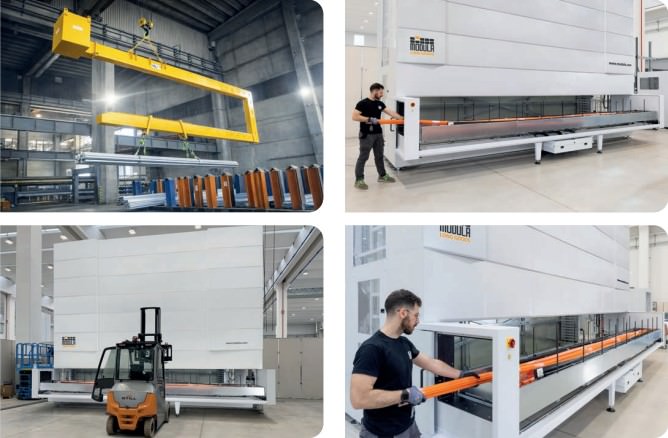
Modula WMS is what maintains consistency across these different worlds. It tracks load units, assigns missions, records movements, updates availability and enables the integration of flows between the VLM, pallet area, goods receiving and shipping. In this way, even mixed logistics, where advanced automation and traditional handling coexist, can be managed as a single system.
Picking Systems: Speed, Accuracy and Multi-Order Management
Picking is one of the areas where integration generates the greatest value. With Modula, picking is already faster and more accurate thanks to the “goods-to-person” principle. But when the VLM is connected to supporting technologies, the process can take a further leap forward.
Put to Light systems, Picking Stations, Pick to Color Carts, Smart Displays, scanners and mobile applications make it possible to manage multiple orders, reduce sorting errors and increase operator productivity.
The Put to Light system helps the operator prepare orders more quickly and accurately. After the item has been picked from the Modula, the display of the correct container lights up, indicating where to place it and in what quantity. The Picking Station makes this activity more comfortable and ergonomic, allowing multiple orders to be managed simultaneously and each operation to be confirmed with a button. The Pick to Color Cart further simplifies the work by associating each cart with a color, so the operator is guided visually without the need for Put to Light. The Smart Display, on the other hand, shows useful information in real time, such as the item image, its position in the tray and picking or depositing details. Finally, scanners help identify materials correctly: they can be standard, industrial or wearable, depending on the environment and the type of operation required.
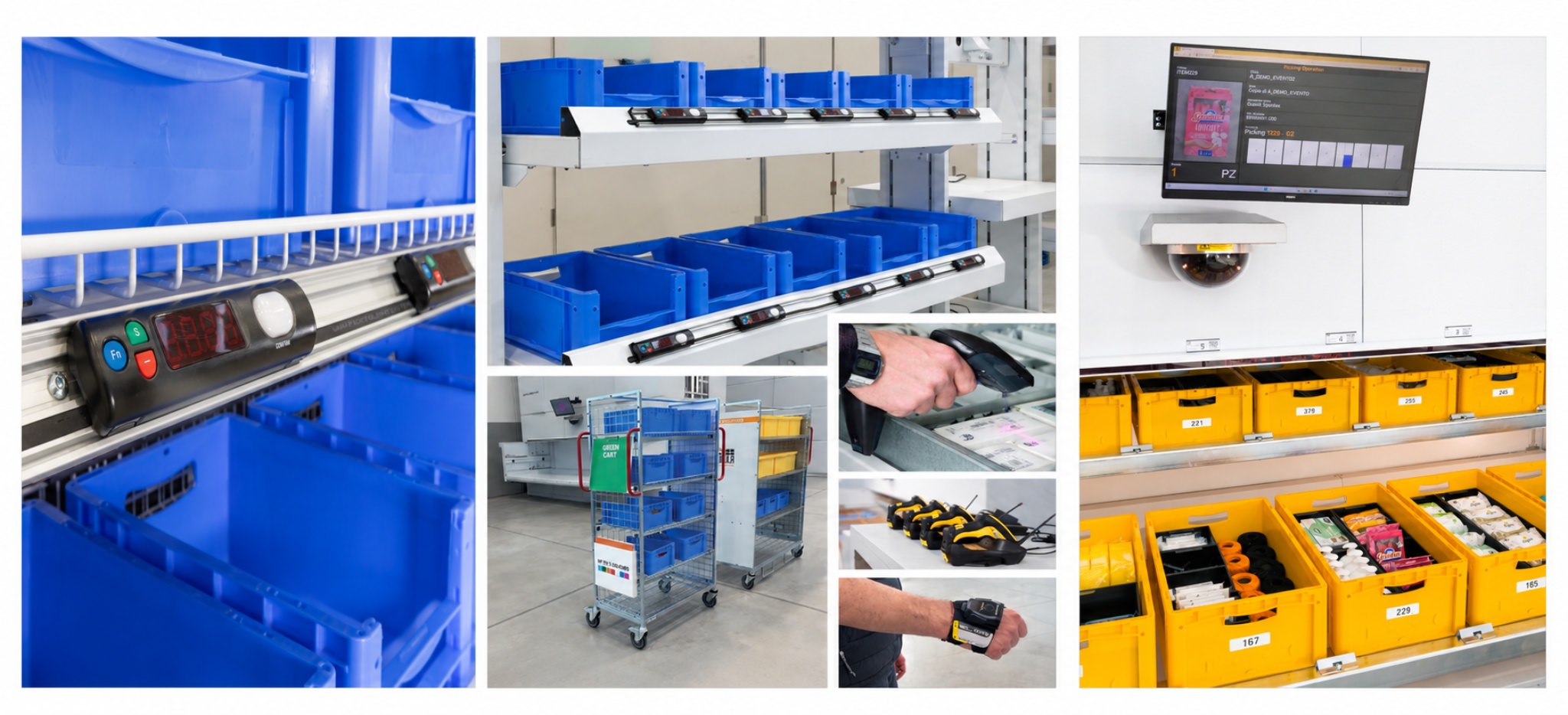
The software guides every phase: it indicates quantities, destination, order association and the confirmations to be carried out, making the flow intuitive even when many order lines are being managed at the same time.
This approach is particularly advantageous in e-commerce, spare parts, components, retail and all businesses that need to prepare many different orders in a short time. Accuracy increases, times are reduced and the operator works in a more ergonomic and less fragmented way.
Traditional Warehouses and Manual Areas: Digitalization Starts Here Too
One often underestimated aspect is that overall warehouse efficiency does not depend only on automated areas. In many companies, automated storage systems, traditional shelving, manual buffers, receiving areas, consolidation areas and mixed departments coexist.
For this reason, it is strategic that the management software is not limited only to automated systems. Modula WMS can also be extended to the traditional warehouse, digitalizing manual areas and bringing order, traceability and process logic to activities that were previously managed in a disconnected way.
The benefit is twofold. On the one hand, the operation of manual areas improves through guided missions, location management, intelligent replenishment and stock control. On the other, continuity is created between the automated world and the traditional one, avoiding information gaps and simplifying the management of the warehouse as a whole.
In this way, integration does not concern only advanced technologies, but the company’s entire logistics infrastructure.
Safety, Ergonomics and Operational Continuity
Integrating Modula with robots, AMRs, conveyors, AGVs and picking systems does not only mean increasing speed. It also means building a safer, more ergonomic and more sustainable work environment over time.
Automation reduces unnecessary movement, limits repetitive activities, decreases exposure to heavy handling tasks and makes material flows more controlled. Operators can focus on higher-value activities, while the system takes care of the most standardized or demanding missions.
Added to this is the issue of operational continuity. A well-integrated ecosystem is more resilient, because each technology plays a precise role within a coordinated logic. If the software manages priorities, missions and availability in real time, the entire process becomes smoother and more predictable.
Integration That Grows with the Company
One of the main strengths of this approach is scalability. There is no need to automate everything at once. A company can start with a Modula VLM, then introduce additional VLMs, advanced picking systems, add conveyors in constant-flow areas, integrate AMRs for internal transport and later connect robots or manipulators to picking operations.
The true element of continuity is Modula WMS, which supports this evolution and keeps the entire ecosystem aligned. It is what enables companies to grow in phases without losing control, traceability or process consistency.
Modula as an Intelligent Hub for Intralogistics
In a context where competitiveness increasingly depends on execution speed, accuracy and the ability to adapt to change, the VLM can no longer be considered an isolated technology.
This is where the real operational advantage emerges. Not from the sum of separate technologies, but from their orchestration. Because a truly efficient warehouse is not only automated: it is connected, synchronized and ready to evolve together with the business.
Automation: the way forward to manage e-commerce logistics